Tag: indonesia

  • Balinese women between tradition and colonial legacy

    Balinese women between tradition and colonial legacy

    By Sanne Breimer

    What motivates a Balinese man to study the only ancient lontar, palm-leaf manuscript that focuses on the role of women in society? I Wayan Juliana is a Balinese scholar who wrote his PhD thesis on Stri Sasana; Stri is the Javanese word for woman or wife, and Sasana means rules and guidance. Juliana’s general interest in manuscripts, as intellectual records of the past, led him to study Stri Sasana—one of the few Balinese language texts about women. 

    Where the Javanese wrote a lot about women, mostly in the context of palace life and kings, Balinese lontars focus more on different aspects of ordinary life, from spiritual topics to administrative ones, like how to conduct financial transactions between two people.

    At first, Juliana thought that the Stri Sasana was about how to be a good woman. The first half of the text has information about how women can take care of themselves. It is about balancing life, caring for the body and face, and finding a good day to do a beauty treatment. For self-care to refill the inner beauty, it has to be based on the Balinese calendar, which combines a lunar calendar with complex astrological and agricultural cycles. 

    While I am speaking with Juliana, lecturer and writer Sonia Piscayanti translates the conversation. It allows checking how much she still follows the old manuscript. For her self-care moments, she does not seek the perfect date. Not all parts of the lontar are still relevant today.  

    The second part of the manuscript talks about practices such as polygamy (“madu” in Balinese language) and how a woman needs to be good to her husband, even if he has multiple wives. It describes how wives should follow his (sexual) desire: there is an obligation to follow the husband’s words, just as a girl would follow her parents.

    Juliana realized after a long analysis of the Stri Sasana that the prescriptions are less about being a good woman and more about attempts to control a woman. He still sees aspects of that in today’s society, in which patriarchy is strongly rooted. 

    Small revolutions from within

    One of Singaraja Literary Festival’s missions is to gain new perspectives on old texts. The lontar manuscripts are not absolute; the Balinese do not have to follow them 100%. In the old times, lontar was known as a literary text, not as the law. But an older generation now refers to lontar regularly, even though they might not have ever read it. Juliana sees researching the scripts as a gateway to discussing the position of Balinese women. Sonia, who is in her forties, adds, “Our generation needs to read it, research it, and open up the discussion.” The younger generation was not allowed to study the text before, but now it is. 

    Balinese women carry many burdens and obligations, and in the village, they even face a double burden both domestically and financially. Juliana says that Balinese society has not found a way yet to change the system. It is so strong that it is almost unthinkable to change it, unless through “small revolutions” from within.

    One of the reasons why change is difficult is that matriarchs keep supporting the system. Mothers-in-law want their daughter-in-law to obey their son. Sonia recognizes the pressure from her husband’s village. She is asked to visit more often and take her duty as a wife seriously, and it is sometimes hard to explain to them that she has teaching to do at university. It does not matter if women have academic titles. Her husband, Made Adnyana Ole, joins the conversation and explains: “They are not viewed for their skills; they are seen as just women, born to do certain things.”

    If it were just for patriarchy, things would be easier, but in Bali, there is a complex mix of paternal structure, religion, and customs. The role of ancestorship is important, not just from an idea that you should do what your grandparents did, but as rooted in religion. In Balinese Hinduism, children follow the lineage and clan of their biological father, and the male members of the family are given higher importance in continuing the ancestral lineage. If the Balinese want to change it, they believe that maybe the family will be cursed.

    “It’s not about logic,” as Sonia says. Religion is different from customs, although cultural rules are more highly respected, and religion can be interpreted differently from one village to another. If a woman wants a divorce, she can fight for her children to the highest court, but that court will eventually obey local laws. And so, to change anything, every single person needs to agree, including the ancestors and the gods.

    When Sonia wrote an essay in 2017 about the fact that Balinese women are not free, she was cursed online and threatened. And so instead, she created a small revolution:
    “I made theater ABOUT it, I did research ABOUT it,” she explains. Addressing these topics through art, metaphorically, leads to seeing things more nuanced than in the past. There has been some change already for Balinese women; some now work as managers in hotels, and Sonia has many female colleagues in university, but as for changing the patriarchal lineage, that is not possible (yet).

    Folktales as a tool to reflect

    Juliana re-read the Stri Sasana lontar more than 20 times and found new things in it continuously. He is always looking for specific quotes to write down and read again. One that stood out for him is about equality, it is used in traditional Vedic and lontar literature, and goes something like:

    “Marriage is the same as taking care of a cow; you need to walk in synchronicity, with the same rhythm, and carry the same amount of burden.”
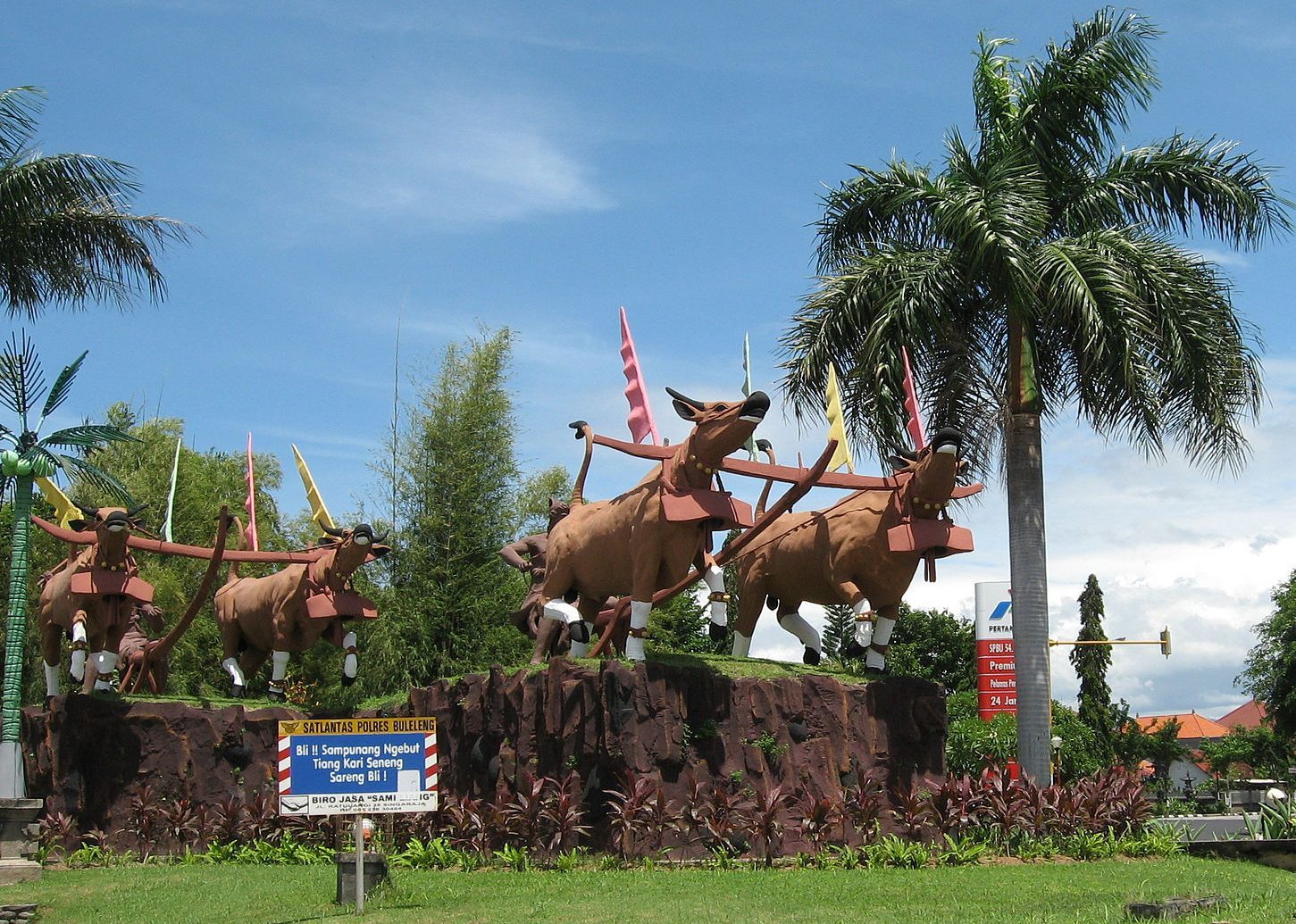
    Cattle racing monument, Banyuasri, Singaraja, Bali, 2009. Wikimedia Commons.

    Sonia’s daughter, Putik, age 18, engages in the discussion and shows me a picture of two oxen pulling a single cart. If one animal pulls harder, walks faster, or refuses to carry the weight, the cart veers off course or flips over. It translates to handling a household together, with the pressure divided between two people, not just carried by one. Stri Sasana teaches that a husband and wife are not independent entities but must move forward together in perfect alignment to maintain balance.

    Several Balinese folktales allow people to discuss inequality and responsibility, as a tool to reflect on daily life. Ole and Juliana mention Cupak Gerantang, a tale about two brothers, of which Cupak is the selfish, greedy, and lazy one, and Gerantang is the hardworking and diligent one. One day, when their mother leaves the house and asks them to clean, Gerantang does all the work, and Cupak takes the credit. It is a moral lesson about greed and jealousy versus diligence and good character. According to Sonia, read through a gender lens, this can resonate with the experience of many Balinese women who perform a disproportionate share of domestic and ritual work while receiving less recognition than men.

    The men come up with another story, about I Sugih and I Tiwas, the rich and the poor. A poor woman asks a rich relative for food, just one grain of rice. But Sugih says she cannot get it. Tiwas then goes to the forest where she encounters a golden deer, and comes back with a fortune. Now the rich person wants to get gifts from the deer also, and copies what the poor woman did. But instead of gold, she receives poop or insects, and dies from poison. She gets punished for her greed. 

    Just as Sonia challenges norms through research, writing, and theatre, folktales also address issues that cannot be spoken about directly. The gender equality discussion in Bali is currently one of the biggest topics in Balinese media, Ole says, and old texts might offer new insights into the conversation. According to him, the problem is that Bali glorifies its strict norms, as if they are part of Bali’s identity. Tourists think the culture is amazing, and the colonial legacy has taught how Bali is supposed to be taken care of to preserve the image of a tropical holiday destination. “That thinking comes from the Dutch,” Ole says.

    The controlled narrative of Bali

    Juliana and Ole mention Ubud — widely considered as the island’s spiritual and cultural heart — as the role model of this identity, where everything is created as a performance. Bali needs to be seen as the reality it is now, not the glorification that the Dutch created. Ole explains how journalists self-censored themselves for a long time, to prevent talking badly about Bali. They would even come up with slogans about how safe it is to live here. The government would get mad about reporting that possibly ruined the image of Bali. If it impacted the stability of Bali as a holiday destination, the permission to broadcast or publish could be taken away. For a long time, under Suharto’s three-decade-long regime (1967-1998), the government controlled the narrative of Bali. When that changed after the Reformasi in 1998, the impact of overtourism became visible. “Journalists gained more freedom to criticize government and business interests and could finally scrutinize mass tourism,” Ole explains. 

    Stories about Bali — including those in journalism — were for a long time framed in moral terms: the good versus the bad. Relating to the karma idea, when you do something bad, something bad will happen to you. Instead of focusing on structural causes of problems, such as business interests or government policies, the stories emphasized individual behavior and its consequences. 

    Just like tourism issues became a matter of individual bad actors rather than development errors, gender problems also focus on women doing good or bad things rather than patriarchal structures underneath. As Sonia describes: “A good Balinese woman does not criticize, protest, or even raise her voice. She is someone who maintains harmony and behaves according to accepted norms.” 

  • Andreas Harsono on Reporting West Papua: Indonesia Must Confront Its Own Deep-seated Racism

    Andreas Harsono on Reporting West Papua: Indonesia Must Confront Its Own Deep-seated Racism

    Andreas Harsono’s three-decade odyssey reveals a land of systemic racism, silenced histories, and a struggle for identity.

    By Akhlis Purnomo

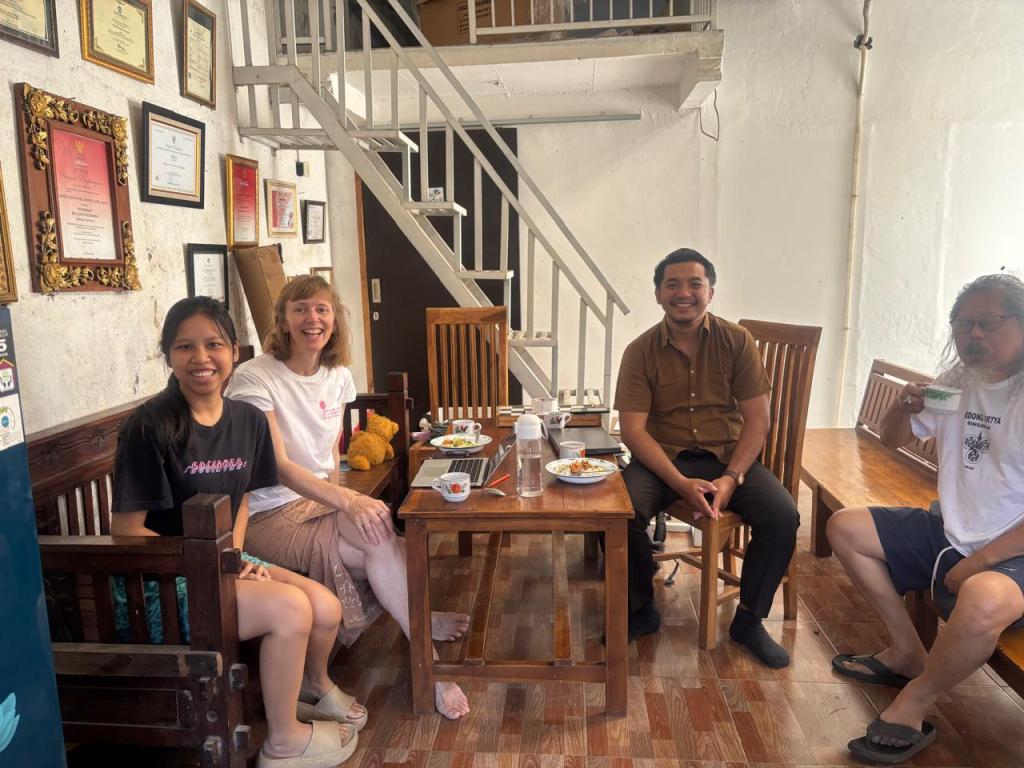
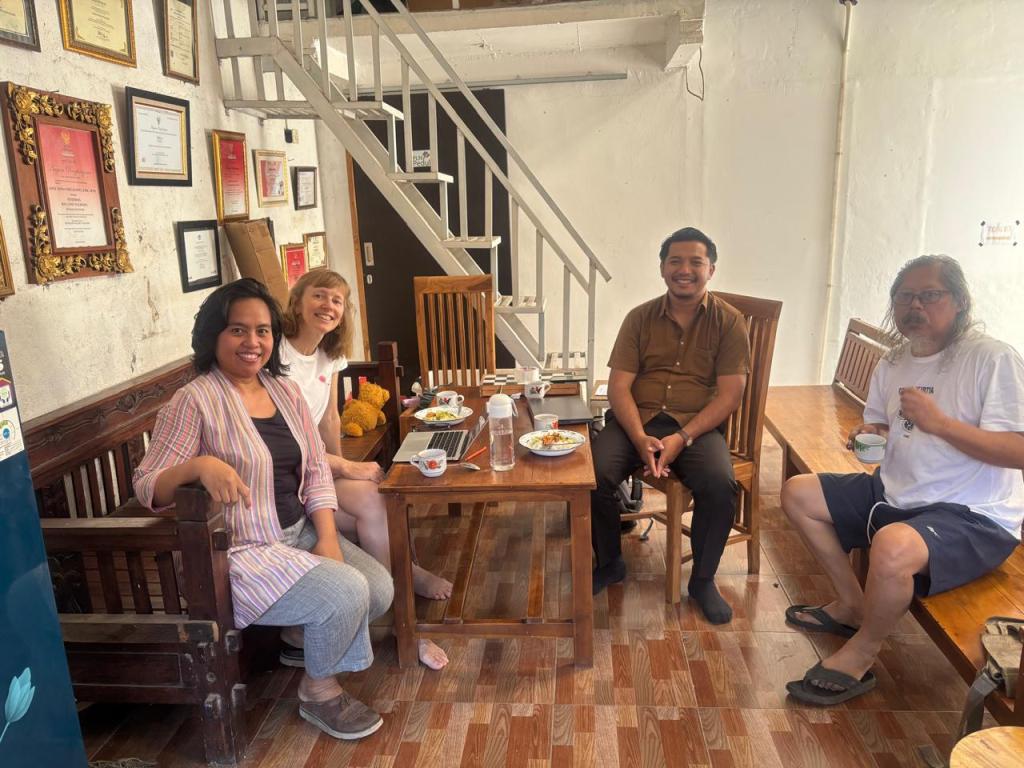
    LEBAK, INDONESIA – The story of West Papua is, for most Indonesians, a story they have never truly been told. Journalist and human rights activist Andreas Harsono unravelled his story and journey of reporting West Papua as he sat down with Cracks on the first Sunday morning (11/2) of November 2025 at the comfort of Compok Cellep, his uniquely designed suburban home in Lebak Regency, Banten Province, Indonesia.

    “I was growing up in an era where we rarely knew what happened in Papua,” Harsono recalled. Born in 1965, the year Indonesia’s military regime solidified its power and the controversial New York Agreement laid the groundwork for West Papua’s future, his childhood was steeped in a single, unchallenged narrative: that West Papua had willingly chosen to integrate with Indonesia. “We were just being told that Irian Barat (now West Papua) had agreed to 100% integrate with Indonesia. There was a massacre in 1977, but there was no news report at all. The military controlled the media tightly.”

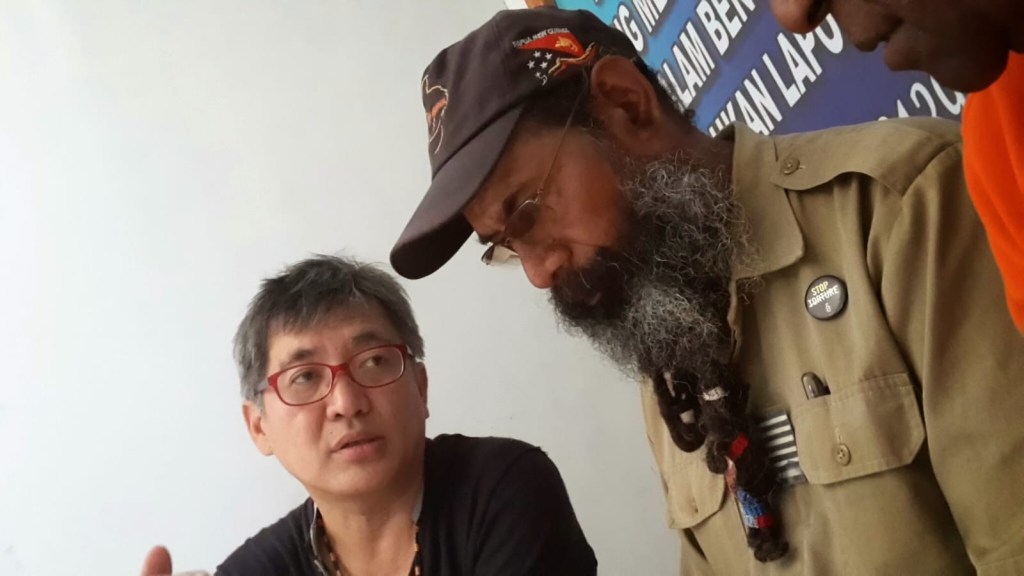
    The facade first cracked in 1996, when Harsono worked as a reporter for Associated Press Television and was dispatched to Wamena to cover the kidnapping of 16 international biologists by the Free Papua Movement (Organisasi Papua Merdeka or OPM). As an Indonesian citizen, he could travel where foreign correspondents were barred. For three weeks, he witnessed the tense negotiations led by Colonel Prabowo Subianto’s Kopassus forces. Subianto himself is now the president of the Republic of Indonesia.

    “I got malaria, too,” he said with a wry smile. “It was the first time I realised that there was something wrong in West Papua.” He saw a reality starkly different from the placid portrayal in Jakarta’s newspapers: widespread human rights abuses and pervasive racism against dark-skinned, curly-haired Papuans. “That was when I started to question my own understanding.”

    That initial questioning ignited a lifelong commitment. From 2008 to 2018, Harsono returned to West Papua every year; his journeys culminating in seminal reports for Human Rights Watch on political prisoners, media blackouts, and, most recently, the deep-seated racism that underpins the conflict. His work, Something to Hide (2015), is not just a chronicle of oppression, but a personal reckoning with his Javanese-Indonesian identity.

    The Four Pillars of a Forgotten Conflict

    Ask Harsono to diagnose the crisis, and he turns not to polemics, but to the sober analysis of Indonesia’s state-owned National Research and Innovation Agency (Badan Riset dan Inovasi Nasional, BRIN). He outlined the four root causes they identified.

    First, and most fundamentally, is the manipulated history of integration. Harsono points to founding father Mohammad Hatta’s early reluctance to include West Papua, citing cultural differences, and the deeply flawed 1969 “Act of Free Choice” where just over 1,000 hand-picked West Papuans, under intense military pressure, voted unanimously for integration. “The history of how West Papua became a part of Indonesia was manipulated,” Harsono stated.

    Second are the systemic human rights abuses. The names of the victims punctuate his sentences like grim milestones: Theys Eluay, a prominent West Papua independence leader, assassinated by the Indonesian Army Special Forces (Kopassus); his driver, Aristoteles Masoka, disappeared; Filep Karma, another pro-independence leader who became a close friend, was imprisoned for raising the banned Morning Star flag. “I get reports and videos every day about human rights abuses from the ground,” Harsono said.

    Third is environmental degradation, where the lush Papuan rainforests are being devoured by palm oil and mining conglomerates. “Freeport was the beginning in 1969,” he noted, referring to the massive American-owned gold and copper mine. “The environment and wildlife are destroyed, and millions of hectares of land are being stolen from the indigenous West Papuans.”

    The fourth is deliberate marginalization. He cites Filep Karma’s book, Seakan Kitorang Setengah Binatang (“As If We Were Animals”), which describes how, in the 1960s, West Papuans owned over 90% of businesses on the capital Jayapura’s main street. Today, many have been pushed to the economic fringe, selling betel nuts on plastic mats. “OPM are systematically implemented,” Harsono explained. “Middle-class, intellectual business owners were accused of sympathizing with the Free Papuan Movement; they were arrested, tortured, and their stores were handed to military-linked businesses.”

    The Complicit and the Courageous: Journalism in the Crossfire

    Navigating this complex and dangerous terrain requires a careful understanding of the media ecosystem itself. Harsono drew a stark distinction between the Suharto-era’s outright propaganda and the more nuanced, yet still troubled, contemporary landscape.

    While independent media outlets like Project Multatuli, Tirto, and Mongabay have produced commendable work about West Papua, a more disturbing phenomenon persists: the infiltration of newsrooms by state intelligence. A leaked military document once revealed over 200 journalists doubling as informants, he said. He wrote in length about the leaked document on Indonesia: Military Documents Reveal Unlawful Spying in Papua (2011).

    “They were divided into two positions,” Harsono explained. “The agents were the full-time intelligence officers pretending to be journalists.” He recounted the case of Victor Mambor, the editor of West Papuan media Jubi.id, who discovered that one of his staff members was a police officer secretly sending daily editorial minutes to his superiors via Facebook Messenger. In another case, an army soldier was found working undercover in a Manokwari Express newsroom.

    Then there are the informers: real journalists who freelance as informers, and are compensated with money or favors, creating a pervasive culture of surveillance and self-censorship. This dynamic often falls along racial lines, between what Papuans call “wartawan rambut lurus” (straight-haired journalists) and “wartawan rambut keriting” (curly-haired journalists).

    “They’re missing the facts on the ground in their narratives,” Harsono said of the complicit media. 

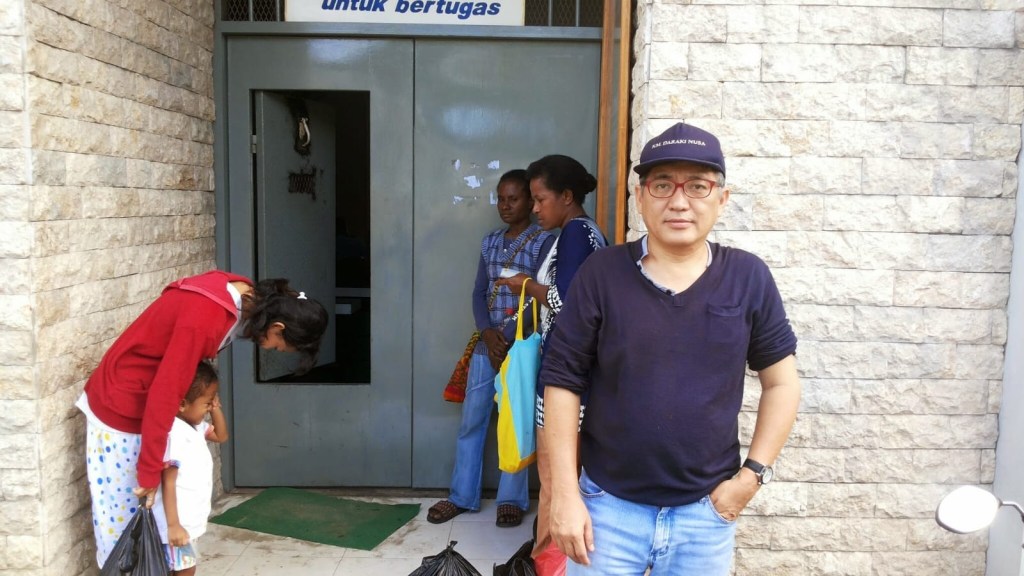
    Andreas Harsono visited the Abepura Correctional Facility in 2014. (Photo credit: Andreas Harsono)

    The Language of Liberation and Control

    In this contested space, even terminology is a battlefield. Harsono navigates it with deliberate precision. He prefers “Indonesian Papua” in English to clarify the region’s current political status, while acknowledging that many Papuans reject the term. He insists on “orang asli Papua” (indigenous Papuan) to distinguish from non-native settlers who call themselves “orang Papua.”

    He is particularly critical of the official label “Kelompok Kriminal Bersenjata” (KKB) or “Armed Criminal Groups” for Papuan militants. “I usually use the term ‘West Papuan militants,’” he said, noting they call themselves the West Papua National Liberation Army (TPNPB). He contextualized their struggle: “They are mostly village guardians who just want to be independent from Indonesia. All of them are upset with the destruction of their forest, their rivers, their waters.”

    He clarified that the enmity is not towards all Indonesians, but primarily towards the security forces and those they referred to as “suanggi” – a Biaknese term for a traitor or sorcerer, now used to describe Javanese or Papuan informants and infiltrators. 

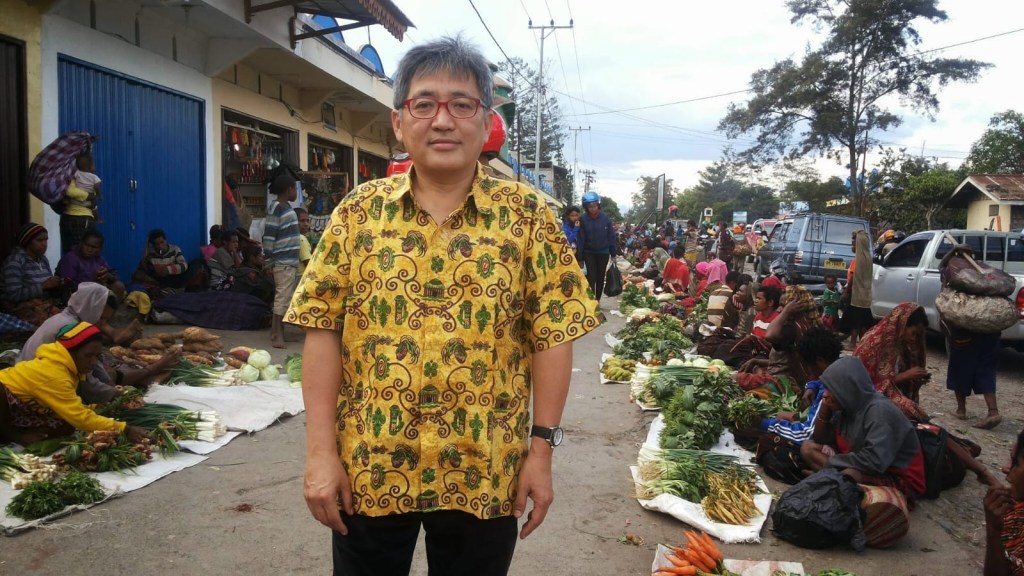
    Andreas Harsono interviewed a number of local women selling produce and herbs in Wamena in November 2014. These West Papuan women said they had no access to bank loans. Permanent kiosks are now owned by non-West Papuan people.  (Photo credit: Andreas Harsono)

    A Vision of Solidarity, Not Solutions

    When asked to envision a decolonized future for West Papua, Harsono became cautious. “I do not oppose the rights to self-determination. I respect Papuans who air their political aspiration to be independent,” he said. “But I also do not support them. Because I know it is a very sensitive issue in Indonesia.”

    His position is not one of political advocacy for independence, but of human rights advocacy and profound personal solidarity. He believes the core issue Indonesians must confront is their own deep-seated racism. “Indonesians, sadly to say, are racist towards dark-skinned and curly-haired people. They often look down on them, saying they are stupid and smelly. They call West Papuans ‘monyet’ (monkeys).”

    This is why Filep Karma’s book title, *As If We Were Animals*, resonates so deeply. It names the dehumanization at the heart of the conflict. For Harsono, solidarity in storytelling means approaching West Papua with an open mind, setting aside the biases of his Javanese, Muslim-majority upbringing to truly listen.

    His connection to the land is also cultural and aesthetic. He spoke with passion of Papuan reggae music, the powerful compilation album of Arnold Ap, the classic folk song “Hai Tanahku Papua,” [‘Oh My Land Papua], and the breathtaking woodcraft of the ethnic Asmat people. 

    For three decades, Andreas Harsono has worked not as a revolutionary, but as a reporter and a witness, meticulously documenting the cracks in Indonesia’s official narrative, one report, one journey, one friendship at a time. His work encouraged us to think that before any problem can be solved, it must first be seen and named for what it truly is.


    This interview was published in Cracks issue #1